Saturday, 29 October 2011

Post 5: Jump Cuts, Over-the-Shoulder Shots, Cutaways and Point of View Shots

Jump Cut
http://encyclopedia.thefreedictionary.com/jump+cut
A jump cut is an immediate transition from one scene to another.
This is an example of a jump cut:


Over-the-Shoulder Shot
http://encyclopedia.thefreedictionary.com/over+the+shoulder+shot
An over-the-shoulder shot is a shot of something or someone taken from over a different persons shoulder.
This is an example of an over-the-shoulder shot:


Cutaways
http://en.wikipedia.org/wiki/Cutaway_(filmmaking)
A cutaway is a when the camera cuts away from the main action for a short period of time by inserting the view of something else.
This is an example of a cutaway shot, it cuts away from the main subject for a short period of time then back to the main subject:


Point of View Shot
http://en.wikipedia.org/wiki/Point_of_view_shot
A point of view shot is a shot from the camera when the audience can see exactly what the character sees, as if they are looking from the characters eyes.
This is an example of a pint of view (POV) shot:
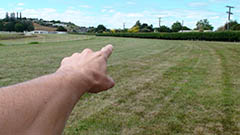
point of view (POV)

Post 4: Script Writing

Shown below is our groups script, it was a group idea and everybody contributed in writing the script. On it we have annotated several different points, identifying why parts were chosen, how we need to keep continuity and different character movements.

Post 3: Continuity

Continuity
http://en.wikipedia.org/wiki/Continuity_(fiction)
Continuity is keeping the consistency throughout the frame, scene or in pictures. This is normally meant when it comes to the mise-en-scene, it makes sure the scene makes sense when watched back so that nothing has moved that shouldn't have.
Below is two pictures that show how continuity is broken from one shot to the next. The pens have been moved from the second shot which shows that the continuity has been broken:


180 Degree Rule/Crossing The Line
http://en.wikipedia.org/wiki/180_degree_rule
The 180 degree rule is a simple guideline that says that two characters in the same scene should always have the same left or right relationship to each other. If the camera passes over an 'imaginary' line of the 180 degree rule this is called crossing the line.
Here is the simple diagram which helps explain the 180 degree rule:


Shot Reverse Shot
http://en.wikipedia.org/wiki/Shot_reverse_shot
Shot reverse shot is when the camera shows one character looking at another character, followed by the camera showing the second character looking back at the first character.
Below are two photo's demonstrating shot reverse shot:


Match on Action
http://en.wikipedia.org/wiki/Cutting_on_action
Match on action is when editors show one action shot then cut over to another different view which matches the first shot's action.